Hardox® 400 vs 450 vs 500: The Cutting Edge Buyer's Guide
Grade-by-grade wear data, real-world hours per inch of wear, and application guidance to help fleet managers and fabricators spec the right Hardox® cutting edge the first time.
Hardox® 400, 450, and 500 are not interchangeable. Each grade trades weldability and toughness for hardness and abrasion resistance in different ways. Picking the wrong one for your application means either paying for hardness you don't need or replacing edges more often than you should. This guide covers what separates the three grades and which one fits which machine and material.
What Is Hardox® Wear Plate?
Hardox® is SSAB's® certified brand of abrasion-resistant wear plate. It is produced to tighter hardness and flatness tolerances than generic AR plate, tested for Charpy impact toughness, and delivered with full mill certifications per heat lot. SSAB® also publishes grade-specific welding and cold-forming guidelines that most generic AR suppliers do not.
Equipment Blades Inc. is an authorized Hardox Wear Parts Center. That means Hardox® plate is cut, formed, and fabricated in-house here in the USA, with SSAB® engineering support behind the product. Customers are not paying Section 232 tariff surcharges on top of the base material cost.
Hardox® is a wear-resistant steel and a hardened steel plate, but it is more precisely described as a certified abrasion-resistant wear plate. The distinction matters because not all hardened steel plate is produced to the same tolerances or tested for impact toughness. Hardox® is one of the few wear-resistant steel products on the market that comes with a guaranteed hardness window and full mill certification per heat lot.
Hardox® is used for cutting edges in three primary ways:
- Full cutting edges fabricated entirely from Hardox® plate (most common for graders, plows, and dozer blades)
- Hardox® wear inserts bolted or welded onto a structural backing bar
- Hardox® bucket lips and floor plates on loader and excavator buckets
Generic AR400 can vary 60 or more HBW between offshore suppliers within the same nominal grade. Hardox® carries a guaranteed hardness window per plate, not just a nominal designation. That consistency is the difference between predictable replacement intervals and guessing when the next edge is due.
 Hardox® 400 vs 450 vs 500: Grade Breakdown
The grade number tracks with the target Brinell hardness. Harder is not always better. Each step up in hardness trades some toughness and weldability for more wear resistance. Here is what each grade actually means for a cutting edge application.
| Property | Hardox 400 | Hardox 450 | Hardox 500 |
|---|---|---|---|
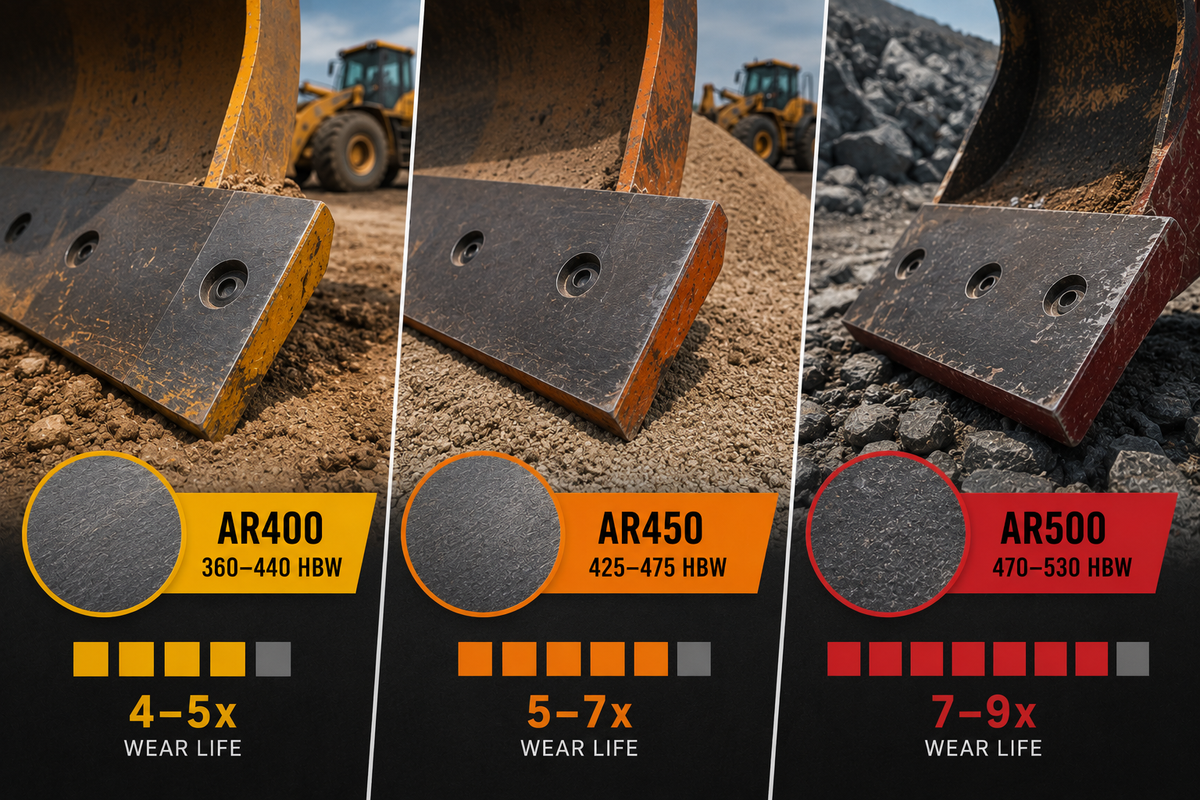
| Brinell hardness (guaranteed range) | 370–430 HBW | 425–475 HBW | 470–530 HBW |
| Tensile strength | ~1,250 MPa | ~1,400 MPa | ~1,600 MPa |
| Impact toughness (Charpy, -20C) | 45J avg | 30J avg | 25J avg |
| Relative wear life vs mild steel | 4–5x | 5–7x | 7–9x |
| Cold forming | Yes, with published bend radii | Limited; larger radius required | Very limited; consult SSAB |
| Preheat required for welding | 100–200 F (plate dependent) | 200–300 F | 300–400 F |
| Best fit | General construction, municipal, aggregate | Hard aggregate, sand, coal fines, mixed conditions | Hard rock mining, taconite, basalt, severe abrasion |
Hardox® 400
The workhorse grade. Hardox® 400 covers the majority of construction and municipal cutting edge applications. It is tough enough to handle impact loading at bucket lips and plow leading edges without cracking, and the weldability is forgiving enough for field repairs with standard low-hydrogen wire and preheat.
Where Hardox® 400 is the right choice:
- Motor grader cutting edges on limestone, caliche, and packed gravel roads
- Snow plow blades on asphalt and concrete surfaces with road grit and salt
- Loader bucket lips in aggregate, topsoil, and mixed material
- Dozer blade face plates in general earthmoving
- Scraper bowl floor plates
Hardox® 450
Hardox® 450 sits between 400 and 500 in hardness, toughness, and weldability. The difference over 400 shows most clearly in fine, high-silica abrasives where sliding contact wear dominates over impact. Sand, coal fines, grain, and wet aggregate all accelerate wear faster than coarse rock, and the added hardness of 450 extends life meaningfully in those conditions.
Where Hardox® 450 earns its place:
- Cutting edges in sand and gravel pit operations
- Loader bucket floors handling fine aggregate or wet concrete
- Conveyor impact bed liners in coal and potash operations
- Skid steer bucket cutting edges in demolition and concrete rubble
- Grader blades in abrasive caliche or decomposed granite
Hardox® 500
Hardox® 500 is the step up for operations where Hardox® 400 is not lasting long enough and the abrasive is hard, fine, and high-silica. The hardness increase from 400 to 500 HBW roughly doubles wear life in the right application. In a high-impact application, that advantage shrinks because the lower toughness of 500 means it is more susceptible to cracking under repeated impact loads.
Where Hardox® 500 makes sense:
- Rock box liners and bucket lips on excavators in hard rock
- Mining haul truck body liners handling hard ore
- Jaw crusher cheek plates and feed chutes in basalt and granite quarries
- Grader blades in iron ore reclaim and taconite operations
- Severe-duty hopper liners in high-silica sand processing
Ordering Hardox® 500 for a mixed dirt and rock application where Hardox® 400 was lasting 1,800 hours rarely fixes the problem. If the failure mode is impact cracking, stepping up in hardness makes it worse, not better. Identify whether the edge is wearing down or breaking before choosing a grade.
Wear Life Comparison: Hours per Inch of Wear
The table below shows approximate wear rates in hours per inch of thickness lost for common cutting edge applications. These numbers are based on field data across multiple operations and are meant as a starting benchmark, not a guarantee. Actual results depend on abrasive type, moisture, blade angle, machine speed, and operator practice.
| Application | Abrasive Type | Hardox 400 | Hardox 450 | Hardox 500 |
|---|---|---|---|---|
| Motor grader: gravel road maintenance | Crushed limestone, packed gravel | 900–1,200 hrs/in | 1,100–1,500 hrs/in | 1,400–1,800 hrs/in |
| Motor grader: caliche or hardpan | Calcium carbonate, fine silica | 600–900 hrs/in | 800–1,100 hrs/in | 1,100–1,500 hrs/in |
| Snow plow: asphalt with road grit | Sand, salt, fine grit | 700–1,000 hrs/in | 900–1,200 hrs/in | 1,200–1,600 hrs/in |
| Loader bucket lip: aggregate | Crushed stone, mixed aggregate | 500–800 hrs/in | 700–1,000 hrs/in | 900–1,300 hrs/in |
| Loader bucket floor: wet sand | Fine silica, high moisture | 350–600 hrs/in | 500–750 hrs/in | 700–1,000 hrs/in |
| Dozer blade: general earthmoving | Mixed soil, gravel, clay | 800–1,200 hrs/in | 1,000–1,400 hrs/in | Not typically specified |
| Mining haul truck body liner: hard ore | Iron ore, granite, basalt | 300–500 hrs/in | 400–650 hrs/in | 600–900 hrs/in |
Hours per inch of wear are approximations based on field observations across multiple fleets and operations. High moisture, angular abrasives, and steep blade attack angles all reduce service life across all grades. Use these figures for planning and grade selection, not warranty estimation.
If you are tracking replacement intervals in hours rather than thickness, use blade wear gauges at scheduled PMs and record actual wear depth per 250 hours. After two or three data points, you can calculate your operation-specific hours per inch and compare it directly to the table above to see whether you are on a Hardox® 400 or Hardox® 500 job.
Which Grade for Which Application?
Start with Hardox® 400 for most construction and municipal work. Move to 450 if fine silica is the dominant abrasive. Move to 500 if 400 or 450 is not lasting and the application is hard rock or high-silica ore. If impact is the main cause of failure rather than abrasion, do not step up in hardness. Look at edge geometry and mounting instead.
- Standard grader blade maintenance: Hardox® 400
- Caliche, decomposed granite, or iron ore grader blades: Hardox® 450 to 500
- Carbide insert edges for extreme rock grading
- See grader cutting edges
- Body plate: Hardox® 400
- Cutting edge: Hardox® 450 or 500 for grit-heavy routes
- Higher grades reduce mid-season swaps on high-mileage routes
- See snow plow blades
- Aggregate and mixed material: Hardox® 400
- Wet sand or fine silica: Hardox® 450
- Toughness matters at the lip; do not over-spec to 500
- See loader wear parts
- General earthmoving: Hardox® 400 face plate
- Hard rock dozing: Hardox® 450 face plate with 400 backing
- See bulldozer wear parts
- Bucket lips: Hardox® 400 to 450
- Rock box floor liners: Hardox® 500 in hard rock
- Cheek plates: Hardox® 400 with 450 option in abrasive rock
- Coal and soft ore: Hardox® 400
- Iron ore, copper ore, granite: Hardox® 450 to 500
- Floor plate typically 1 grade harder than side liners
- General material: Hardox® 400 throughout
- Demolition and concrete rubble: Hardox® 450 cutting edge
- See skid steer wear parts
- Grader and plow bodies: Hardox® 400
- High-mileage plow cutting edges: Hardox® 450 to 500 to reduce mid-season replacement
- Lower total annual cost even at higher unit price
What About Hardox® 500 Tuf?
Hardox® 500 Tuf is a variant of Hardox® 500 with improved impact toughness compared to standard 500. SSAB® developed it specifically for applications where both hard abrasion and significant impact occur simultaneously, in environments where standard 500 was cracking in service.
The hardness spec is the same as standard Hardox® 500 (470 to 530 HBW), but the Charpy impact value is substantially higher. That makes 500 Tuf relevant in these situations:
- Mining buckets handling hard, angular ore where the lip takes repeated blows
- Rock box liners on excavators in blasted granite or basalt
- Feed chutes in primary crushing circuits where large rocks drop onto the liner
- Dozer blades ripping hard rock where standard 500 was cracking at the ends
For pure sliding abrasion applications with minimal impact, conveyor liners, chute floors, grader blades on packed roads, standard Hardox® 500 is adequate and less expensive than Tuf. If you are seeing cracking rather than wear-through on Hardox® 500 parts, 500 Tuf is worth specifying on the next order.
Hardox® 500 Tuf is available through Equipment Blades on special order. Lead time is longer than standard 400, 450, and 500 stock. Contact us through the custom manufacturing page with your thickness, quantity, and timeline.
When to Consider Hardox® 600
Hardox® 600 targets 570 to 640 HBW, which puts it in a different category from the three grades most construction and municipal operations will ever use. It is intended for the hardest abrasion environments: taconite processing, basalt quarrying, and hard-rock mining where even Hardox® 500 wears through too quickly.
Hardox® 600 cannot be cold formed. Welding requires specialist procedures including high preheat and controlled interpass temperature. The cost per pound is significantly higher than 500. For most cutting edge applications on construction or mining equipment, Hardox® 500 is the practical ceiling. Hardox® 600 shows up in stationary processing equipment: chute liners, wear plates in crushing circuits, and impact zones in high-throughput ore handling.
If you are getting to the point where Hardox® 500 is not lasting and you are considering 600, also evaluate chromium carbide overlay plate. CCO offers very high surface hardness on a tough backing material and may give better service life in pure sliding abrasion without the welding challenges of AR600.
Hardox® 550 (targeting 525 to 575 HBW) sits between 500 and 600 and is used in severe-duty mining applications where 500 is wearing through but 600 is more than the budget or fabrication process supports. Contact Equipment Blades for availability and lead time on 550 plate.
Welding and Field Repair
Hardox® grades are weldable, but the procedures vary by grade. The main risk in all AR steel welding is hydrogen-induced cold cracking (HICC), which can develop hours or days after the weld is complete. Following preheat and cooling requirements eliminates most of this risk.
Hardox® 400 Field Repair
- Preheat to 100 to 200 F depending on plate thickness (thicker requires higher preheat)
- Use E7018 or E8018 low-hydrogen stick, or ER70S-6 solid MIG wire
- Wrap completed weld in insulating blanket for 30 minutes minimum
- Standard crews can handle this with existing equipment and some practice
Hardox® 450 Field Repair
- Preheat to 200 to 300 F; do not skip this on plates over 1/2 inch
- Low-hydrogen consumables required: E8018 stick or ER80S-D2 MIG wire
- Controlled slow cool after welding; blanket wrap is standard practice
- Harder to do well in the field; shop welding is preferred for critical joints
Hardox® 500 Field Repair
- Preheat to 300 to 400 F; use a contact thermometer to verify
- Low-hydrogen flux-cored wire recommended over solid wire for better penetration control
- Get a written welding procedure from SSAB or your filler metal manufacturer before starting
- Post-weld heat treatment at 300 F for one hour per inch of thickness is recommended for structural welds
- Field repairs on Hardox® 500 should be avoided unless properly equipped and trained
Welding Hardox® 450 or 500 without preheat on a cold morning in the field and finding a crack in the weld two days later is a well-documented failure mode. The crack is not always visible at the surface. If a structural weld is holding a cutting edge on a machine, follow the procedure. A failed edge weld is a safety issue, not just a maintenance issue.
Cost per Hour of Wear Life
The unit price of a Hardox® 500 cutting edge is higher than Hardox® 400. Whether that premium pays off depends on your operation. Here is a simplified way to think about it.
Assume a motor grader running caliche roads gets 700 hours per inch of wear out of Hardox® 400 and 1,100 hours per inch out of Hardox® 500. If a 1-inch-thick edge costs $280 in Hardox® 400 and $360 in Hardox® 500:
- Hardox® 400: $280 / 700 hours = $0.40 per operating hour
- Hardox® 500: $360 / 1,100 hours = $0.33 per operating hour
In that scenario, Hardox® 500 costs less per operating hour despite the higher unit price, and you avoid one extra edge change per replacement cycle. For a fleet of 10 graders, that difference compounds significantly across a season.
The math flips when the application is low-abrasion and Hardox® 400 is already lasting the full maintenance cycle. Spending more on 500 in that situation gives no return. Run the numbers for your specific hours and edge price before making a grade change.
What to Ask When Ordering Hardox® Cutting Edges
Whether you are ordering stock edges or custom-fabricated parts, get clear answers to these questions before placing the order:
- What grade is this edge? Ask for the Hardox® grade designation and confirm it comes with SSAB® mill certification. "AR500" and "Hardox® 500" are not the same thing; the certified tolerances are different.
- What is the actual measured hardness on this heat lot? Request the HBW value from the MTR. A legitimate Hardox® distributor has this on file for every plate.
- What thickness options are available? Standard cutting edges run from 5/8 inch to 1-1/2 inches depending on application. Heavier-duty applications often justify the next thickness up, which extends life without changing grade.
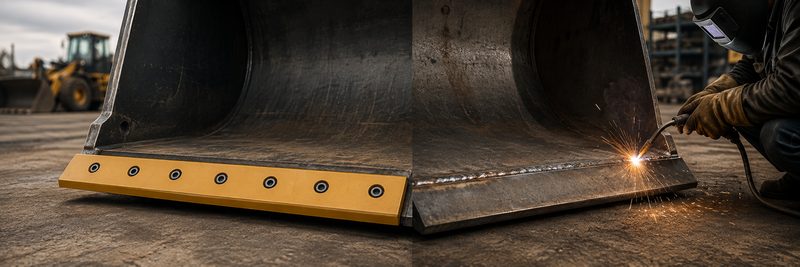
- Are the bolt holes pre-drilled? Drilling Hardox® 450 or 500 in the field is slow and hard on bits. Pre-drilled edges save significant installation time. Equipment Blades supplies pre-drilled edges to your bolt pattern.
- What is the lead time for your size and quantity? Stock sizes ship in 1 week or less. Custom lengths, widths, or non-standard bolt patterns require production scheduling. Confirm before committing to a project timeline.
- Is the steel produced in the USA? Country of origin affects Section 232 tariff exposure. Equipment Blades fabricates from USA-sourced Hardox® plate with no tariff surcharges passed to the customer.
- What welding procedure do you recommend for field repairs? A distributor who cannot answer this is not working closely with the material. Get the preheat spec and filler metal recommendation in writing before you need it on a job site.
Frequently Asked Questions
Hardox® steel is SSAB's® certified brand of abrasion-resistant wear plate. It is a quenched and tempered, high-carbon steel produced to guaranteed Brinell hardness tolerances of plus or minus 30 HBW per plate. Unlike generic AR plate, Hardox comes with full mill certifications per heat lot, published welding procedures, and tested Charpy impact toughness. It is used in cutting edges, bucket liners, truck body liners, chute liners, and other wear parts on construction, mining, and municipal equipment worldwide.
Hardox® wear plate is produced by SSAB®, a Swedish steel company with manufacturing operations in Sweden and Finland. The plate is available worldwide through authorized distributors. Equipment Blades Inc. is an authorized Hardox® Wear Parts Center that fabricates Hardox® cutting edges and wear parts in the USA. Customers ordering through Equipment Blades receive USA-fabricated parts with no Section 232 steel tariff surcharges on top of the base material cost.
Hardox® can be welded with standard MIG or stick equipment, but the procedure varies by grade. For Hardox® 400, preheat to 100 to 200 F depending on plate thickness and use low-hydrogen solid wire such as ER70S-6 or E7018 stick. For Hardox® 450, preheat to 200 to 300 F minimum and use E8018 or ER80S-D2. For Hardox® 500, preheat to 300 to 400 F, use low-hydrogen flux-cored wire, and follow a written welding procedure from SSAB® or your filler metal manufacturer. After welding, wrap the weldment in an insulating blanket for at least 30 minutes to slow cooling and prevent hydrogen-induced cold cracking. Do not skip preheat, particularly on plates thicker than 1/2 inch.
Hardox® is SSAB's® certified brand of abrasion-resistant wear plate. It is produced to tighter hardness and flatness tolerances than generic AR plate and comes with full mill certifications per heat lot. Available grades include Hardox® 400, 450, 500, 500 Tuf, and 600. It is the most widely specified certified AR plate brand used in construction, mining, and municipal equipment wear parts.
Hardox® 400 has a guaranteed hardness of 370 to 430 HBW and provides roughly 4 to 5 times the wear life of mild steel. Hardox® 500 has a guaranteed hardness of 470 to 530 HBW and provides 7 to 9 times the wear life of mild steel. Hardox® 400 is easier to weld, more impact-tough, and can be cold formed with the correct bend radius. Hardox® 500 lasts significantly longer in high-silica fine abrasive environments but requires higher preheat when welding and has very limited cold-forming capability. For most construction and municipal applications, Hardox® 400 is the correct starting grade. Step up to 500 when 400 is not lasting long enough and the application involves hard, fine abrasives rather than impact-dominated loading.
Hardox® 450 is approximately 50 HBW harder than Hardox® 400 and provides roughly 5 to 7 times the wear life of mild steel compared to 4 to 5 times for 400. The difference shows most clearly in fine, high-silica abrasives like sand, coal fines, and wet aggregate. In coarse aggregate or mixed material applications, the gap between the two grades is smaller. Hardox® 450 requires a higher preheat when welding and needs a larger bend radius for cold forming, but both operations are still practical with standard shop equipment.
Hardox® 500 Tuf is a variant of Hardox® 500 with improved impact toughness while maintaining the same hardness range of 470 to 530 HBW. It was developed for applications where standard 500 was cracking under high-impact loading. Common uses include mining buckets in hard angular ore, rock box liners on excavators, and primary crusher feed chutes where large material drops directly onto the liner. For pure sliding abrasion with minimal impact, standard Hardox® 500 is adequate and less expensive.
Service life varies significantly by application and abrasive type. In general construction and road maintenance conditions, a Hardox® 400 cutting edge on a motor grader runs 900 to 1,200 hours per inch of thickness in packed gravel or limestone. In more abrasive conditions like caliche or iron ore, that number drops to 600 to 900 hours per inch. Hardox® 500 in the same caliche application runs 1,100 to 1,500 hours per inch. Track actual wear depth at PMs using a blade gauge and calculate your operation-specific rate before comparing grades.
Hardox® 400 can be welded in the field with standard MIG or stick equipment using low-hydrogen wire or electrodes and proper preheat of 100 to 200 F. Hardox® 450 requires preheat of 200 to 300 F and low-hydrogen consumables; it is manageable in the field with the right setup. Hardox® 500 should be avoided for field welding if possible because it requires 300 to 400 F preheat and controlled slow cooling. If a Hardox® 500 structural weld fails in the field, the correct fix is shop repair, not a quick field bead.
It depends on your application. In high-silica abrasive conditions like caliche road grading or hard aggregate handling, Hardox® 500 typically delivers 50 to 70 percent more wear life than 400. If that additional life exceeds the price premium, which it often does when you factor in installation labor and machine downtime for edge changes, 500 costs less per operating hour despite the higher unit price. In low-abrasion applications where Hardox® 400 already lasts through the full maintenance cycle, stepping up to 500 adds cost without adding benefit.
Hardox® carries a guaranteed hardness range per plate (plus or minus 30 HBW), tested Charpy impact toughness per heat, and full mill certifications with chemistry, hardness, and tensile data. Generic AR plate at the same nominal grade can vary 60 or more HBW between suppliers. SSAB® also publishes grade-specific welding and bend radius guidelines that generic AR suppliers typically do not provide. For procurement teams writing long-term service specifications, the documented data is useful for bid documents. For contractors, the tighter hardness range means more predictable replacement intervals.
Equipment Blades stocks certified Hardox® cutting edges in standard sizes for graders, plows, loaders, and dozers and can ship most orders in one week or less. Custom lengths, widths, and non-standard bolt patterns are fabricated in-house at our USA facility. Contact the team through the custom manufacturing page with your part geometry, grade, thickness, and quantity for a quote and lead time.
Equipment Blades fabricates Hardox® cutting edges in the USA using domestically processed plate. Customers are not paying Section 232 tariff surcharges on top of the base material cost. If you are sourcing Hardox® edges from an overseas distributor or importer, confirm whether tariff costs are included in the quoted price before comparing it to Equipment Blades pricing.
Hardox® Extreme is SSAB's® highest-hardness commercial wear plate, targeting 650 to 700 HBW. It is used in the most severe sliding abrasion applications in hard rock mining and mineral processing. Hardox® Extreme cannot be cold formed and requires specialist welding procedures. It is not practical for most cutting edge applications on mobile equipment. If you are running Hardox® 600 and still seeing unacceptably short service life, Extreme is the next consideration, but it is a niche product used by a small number of high-throughput mining operations.