Article: How Long Should Bucket Cutting Edges Last? 5 Variables That Control Wear Life
How Long Should Bucket Cutting Edges Last? 5 Variables That Control Wear Life
What controls how long your bucket cutting edges last, and how to get more hours out of every set.
There is no single answer to how long a bucket cutting edge lasts. The honest range is 300 hours to over 2,000 hours depending on five variables that are entirely within your control. This guide covers each one and shows you how to use them to predict replacement intervals, justify upgrade decisions, and reduce the cost per operating hour on your fleet.
Why Wear Life Varies So Much
A bucket cutting edge on a wheel loader working topsoil and mulch can last 1,500 hours or more. The same edge on a loader filling a crusher from a pile of wet granite sand might last 400 hours. Same machine, same steel, different application.
The five variables below explain the full range. They work in combination, which means improving even two of them can double your service life. Understanding them is more useful than asking "how long should this last" because that question has no answer without knowing your specific conditions.
What the bucket is digging, pushing, or loading, and how hard and angular the particles are.
The Brinell hardness of the cutting edge determines its baseline wear resistance.
More material means more wear life, up to a point where weight and balance become factors.
How the bucket enters, loads, and dumps material directly affects how fast edges wear.
When edges are inspected and replaced affects both safety and total cost per cycle.
Variable 1: Material Type and Abrasivity
The material your bucket handles is the single biggest driver of wear life. Not all dirt is the same. The two properties that matter most are hardness and angularity of the particles.
Silica Content
Silica is the primary abrasive in most natural materials. Sand, granite, quartzite, and caliche all have high silica content. They cut steel surfaces at the microscopic level through a process called micro-gouging. The higher the silica content, the faster the wear.
Topsoil, clay, loam, and organic material have low abrasive indexes. Edges working these materials wear slowly regardless of steel grade. Specifying expensive high-hardness steel for a machine that only works topsoil is not a good investment.
Particle Angularity
Rounded particles roll across the steel surface. Angular particles cut it. Crushed rock from a quarry has freshly fractured, angular edges and wears steel 30 to 50 percent faster than river gravel of the same composition, even though both are the same rock type.
Moisture
Wet material is generally more abrasive than dry. Water carries fine abrasive particles into direct contact with the steel surface and prevents a thin layer of material from building up that would otherwise reduce metal-to-metal contact. Wet sand is one of the most aggressive conditions for bucket edges.
Material Abrasivity Reference
| Material | Relative Abrasivity | Notes |
|---|---|---|
| Topsoil, loam, compost | Very low | Low silica, soft particles |
| Clay | Low | Sticky and soft; minimal cutting action |
| Mixed earthmoving (soil and gravel) | Low to medium | Common construction excavation |
| Crushed limestone, packed gravel | Medium | Common road base and aggregate |
| River sand and gravel | Medium to high | Rounded particles; less cutting than crushed |
| Crushed granite, basalt, quartzite | High | Angular, high-silica; aggressive on edges |
| Wet fine sand | Very high | Fine silica particles carried into contact by water |
| Iron ore, taconite | Very high | Hard, dense, and high-silica |
| Coal | Low to medium | Soft material; edges last comparatively long |
| Concrete rubble | High | Angular, hard; also contains rebar impact risk |
If you are running the same machine in multiple materials across a week, your wear life will be a weighted average. A loader that spends 60 percent of its time in topsoil and 40 percent in gravel will have edges that last much longer than one running gravel all day. Track hours by material type when comparing edge life across machines in a mixed fleet.
Variable 2: Steel Grade and Hardness
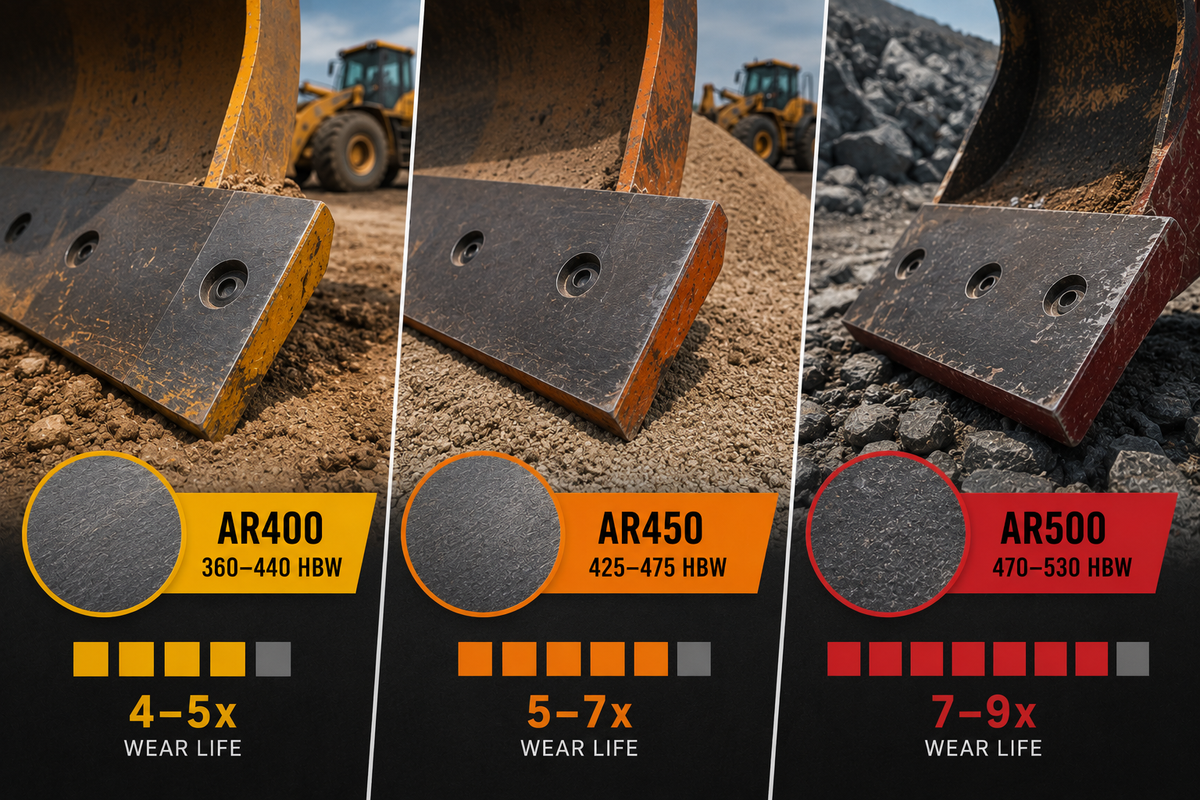
Cutting edge steel is rated by Brinell hardness (HBW). The higher the number, the harder the steel and the more abrasion-resistant the edge. Most OEM bucket edges run 400 to 450 HBW. Aftermarket options extend from standard carbon steel at 300 to 350 HBW up to Hardox® 500 at 470 to 530 HBW.
What Hardness Actually Does
Harder steel resists the micro-gouging and plowing action that removes material from the edge surface. A harder edge loses less thickness per hour of operation in the same application. The relationship is not linear: going from 400 to 500 HBW does not add 25 percent more life. In high-silica abrasive conditions it can double service life.
Grade Comparison
| Steel Grade | Brinell Hardness | Relative Wear Life | Best For |
|---|---|---|---|
| Standard carbon steel (OEM) | 300–350 HBW | 1x baseline | Light-duty, low-abrasion applications |
| AR400 | 360–440 HBW | 1.8–2.5x | General construction and municipal work |
| Hardox® 400 | 370–430 HBW (guaranteed) | 2–2.5x | Construction, aggregate, mixed material |
| Hardox® 450 | 425–475 HBW (guaranteed) | 2.5–3.5x | Sand, fine aggregate, coal, mixed abrasives |
| Hardox® 500 | 470–530 HBW (guaranteed) | 3.5–5x | Hard rock, granite, iron ore, wet sand |
Wear life multipliers are measured against standard OEM carbon steel in moderate abrasive conditions. The advantage of harder grades grows significantly in high-silica applications.
Generic AR400 can vary 60 or more HBW between suppliers within the same nominal grade. Certified Hardox® plate carries a guaranteed hardness range per plate with full mill documentation. When you are comparing prices, make sure you are comparing the same actual hardness, not just the same grade name. Equipment Blades stocks certified Hardox® cutting edges with 1-week turnaround. See Hardox® wear parts.
When Harder Is Not Better
Harder steel trades toughness for hardness. In high-impact applications like concrete demolition, rock breaking, and buckets that hit boulders repeatedly. Very hard edges can crack or chip. If your current edges are cracking rather than wearing smooth, the solution is not to spec harder steel. It is to spec a grade with better impact toughness, such as Hardox® 500 Tuf, or to look at edge geometry and mounting.
Variable 3: Edge Thickness and Profile
A thicker edge simply has more material to wear through before replacement. This is the most straightforward variable: doubling the thickness from 1/2 inch to 1 inch roughly doubles the replacement interval, assuming wear is even across the face.
Standard Thickness Options
- 5/8 inch: Common for smaller loader buckets and skid steers in light applications
- 3/4 inch: Standard for mid-size loaders in mixed material
- 1 inch: Common upgrade for loaders in aggregate or mining operations
- 1-1/4 to 1-1/2 inch: Heavy-duty spec for severe abrasion or high-throughput operations
Edge Profile
Most bucket cutting edges are flat bar stock. Some operations use reversible edges with two usable faces, which effectively doubles usable life before replacement. Double-bevel profiles penetrate material more efficiently and reduce the force required to fill the bucket, which reduces wear on other bucket components.
Carbide-insert edges are a different category. The base steel wears, but the carbide inserts are harder than any abrasive and resist wear almost entirely. In very high abrasion applications, carbide inserts on a steel backing bar can outlast Hardox® 500 by 3 to 5 times. The trade-off is cost and brittleness under impact. See carbide bits and boards for options.
Specifying a thicker edge without checking bucket capacity and machine lift ratings. A 1-1/2 inch Hardox® 500 edge on a small loader adds significant weight at the bucket lip. Confirm the machine's rated capacity before upgrading thickness, particularly on compact equipment.
Variable 4: Operator Technique
Operator habit is one of the most overlooked wear variables because it is invisible in a maintenance report. Two operators running the same machine in the same material can produce replacement intervals that differ by 30 to 40 percent.
Practices That Accelerate Wear
- Dragging the bucket on the ground while traveling. Even a few feet of ground contact per cycle adds up to thousands of feet over a shift. This wears the cutting edge face and the bottom of the bucket shell.
- Crowd angle too steep. Driving the bucket into the pile at an aggressive angle concentrates all the load on the cutting edge rather than distributing it across the lip. This causes rapid edge wear and can crack the edge in hard material.
- Spinning out on abrasive material. Wheel spin while crowding the pile drives the cutting edge into the material under high friction force.
- Dumping onto hard surfaces. Dropping a loaded bucket onto concrete or rock from height concentrates impact on the leading edge.
- Using the bucket edge as a dozing tool. Pushing material across a pad with a loader is hard on cutting edges because it keeps the edge in constant contact with the ground under load.
Practices That Extend Wear Life
- Keep the bucket raised off the ground while traveling between loading and dump points
- Match crowd angle to material: softer material allows steeper entry, harder material benefits from a shallower approach
- Fill the bucket with multiple passes rather than forcing full penetration on the first crowd
- Let the bucket teeth do the penetration work before the lip makes contact
- Avoid grounding the bucket edge during finish grading passes
If edges on one machine in your fleet consistently wear faster than edges on a similar machine doing similar work, the cause is usually operator technique. Track edge hours by operator, not just by machine. A 30 percent difference in edge life between operators on the same machine is a training opportunity, not a materials problem.
Variable 5: Maintenance Practices
How you manage inspection and replacement intervals directly affects total cost, sometimes more than the steel grade does.

Inspect at Every PM
Bucket cutting edges should be inspected at every scheduled PM, not just when an operator reports a problem. By the time the operator notices the edge is gone, the bucket shell is often already contacting the material. Shell damage is significantly more expensive to repair than a worn edge.
What to measure at each inspection:
- Remaining thickness at the center and both ends of the edge
- Wear pattern: is it even across the face or concentrated on one end?
- Presence of cracks, chips, or missing sections
- Bolt hole condition: elongated holes indicate the edge has shifted and needs replacement
- Bucket shell: any contact marks or wear grooves behind the edge position
Replace Before the Bucket Shell Is at Risk
A rule used across many operations: replace bucket cutting edges when they have lost 50 to 60 percent of original thickness. Waiting until the edge is completely worn saves one set of edges but risks the bucket shell, which costs 5 to 20 times more to repair or replace.
Rotate or Flip Reversible Edges
If your edges are reversible, flip them before the leading face is consumed. Waiting too long means the second face is not usable because the mounting holes have worn through. Flip at the same 50 percent wear threshold.
Track Replacement Intervals
Record the date, machine hours, and material type every time an edge is replaced. After three or four replacement cycles you will have enough data to predict the next replacement within 100 to 200 hours. This makes parts inventory planning straightforward and eliminates emergency orders.
Drilling through hardened AR plate in the field is slow and hard on bits. Ordering edges pre-drilled to your bolt pattern eliminates field drilling entirely and cuts installation time significantly. Equipment Blades supplies pre-drilled cutting edges to your existing bolt pattern. Contact us through the custom manufacturing page.
Wear Life Benchmarks by Application
The table below shows realistic replacement intervals for bucket cutting edges by application and steel grade. These are field-based approximations. Your actual numbers will depend on all five variables, but these ranges give a planning baseline.
| Application | Material | Standard Carbon Steel | Hardox® 400 | Hardox® 500 |
|---|---|---|---|---|
| Loader: topsoil, compost, mulch | Very low abrasion | 1,500–2,500 hrs | Overkill for most operations | Overkill for most operations |
| Loader: mixed earthmoving | Soil, gravel, clay | 800–1,400 hrs | 1,500–2,500 hrs | Not typically specified |
| Loader: crushed aggregate | Limestone, gravel, base | 400–700 hrs | 800–1,400 hrs | 1,200–2,000 hrs |
| Loader: wet sand | Fine silica | 250–450 hrs | 500–800 hrs | 800–1,200 hrs |
| Excavator: general earthmoving | Soil, clay, soft rock | 600–1,200 hrs | 1,200–2,200 hrs | Not typically specified |
| Excavator: hard rock | Granite, basalt, quartzite | 200–400 hrs | 400–700 hrs | 700–1,200 hrs |
| Skid steer: general | Mixed material | 500–900 hrs | 1,000–1,800 hrs | Not typically specified |
| Skid steer: demolition | Concrete, rubble | 200–400 hrs | 400–700 hrs | 600–1,000 hrs |
| Mining loader: hard ore | Iron ore, granite, taconite | 150–300 hrs | 300–550 hrs | 550–900 hrs |
Hours shown are for standard 3/4 inch thick edges. Add 25 to 35 percent for 1-inch edges. Wet conditions, angular abrasives, and steep crowd angles all reduce service life toward the lower end of each range.
Calculating Cost per Hour
Unit price alone does not tell you which edge is cheaper to run. The right comparison is cost per operating hour, which accounts for both the price of the edge and how long it lasts.
Example: a loader working crushed aggregate.
- Standard carbon steel edge at $85, lasting 500 hours: $0.17 per hour
- Hardox® 400 edge at $140, lasting 1,100 hours: $0.13 per hour
- Hardox® 500 edge at $175, lasting 1,600 hours: $0.11 per hour
In this scenario, the Hardox® 500 edge costs the least per operating hour despite being the highest unit price. And each additional replacement also carries installation labor, typically 30 to 60 minutes per edge change. Reducing the number of changes per year reduces that labor cost as well.
Run this calculation for your specific operation before choosing a steel grade. The math frequently justifies a step up in hardness even when the unit price difference looks significant.
When to Replace Bucket Cutting Edges
Replace bucket cutting edges when any of the following conditions are present:
- 50 to 60 percent of original thickness has worn away. At this point the edge still protects the bucket shell but replacement is overdue before the next scheduled PM.
- Uneven wear has created a beveled leading edge. Once the leading face is angled back significantly, penetration force increases and fuel consumption goes up.
- Cracks are visible anywhere on the edge face or body. A cracked edge is a safety hazard. A fragment under load can separate and become a projectile.
- Bolt holes are elongated or wallowed out. Edge movement under load accelerates wear on the bucket shell mounting points. Replace the edge and inspect the bolt holes in the bucket shell.
- The bucket shell shows contact wear behind the edge position. This means the edge is already too worn to protect the shell. Replace immediately and assess shell damage.
- Material fill rate has dropped noticeably. Operators often notice the bucket is harder to fill or requires more passes before the edge has worn enough to be visible. If productivity has dropped, check the edge thickness.
Running cutting edges until they are completely consumed saves one set of edges per machine per year at the cost of accelerated bucket shell wear. The bucket shell on a mid-size wheel loader costs 4 to 8 times more than a full set of cutting edges. The math does not support waiting until the edge is gone.
Frequently Asked Questions
The honest range is 200 to 2,500 hours depending on material abrasivity, steel grade, edge thickness, operator technique, and maintenance practices. A loader working topsoil with Hardox® 400 edges can exceed 2,000 hours. The same machine in wet granite sand with standard carbon steel edges might last 250 hours. Identify which of the five variables is limiting your wear life before changing anything else.
Start with Hardox® 400 for most construction and municipal applications. It provides 2 to 2.5 times the wear life of standard OEM carbon steel at a cost per operating hour that is typically lower despite the higher unit price. Step up to Hardox® 500 when Hardox® 400 is not lasting long enough and the application involves hard, angular, or high-silica material. For very high-abrasion environments like wet sand, iron ore, or granite quarrying, Hardox® 500 is the right starting point.
Replace when the edge has lost 50 to 60 percent of its original thickness. Do not wait until it is gone. Other replacement triggers include visible cracks, elongated bolt holes, contact wear on the bucket shell behind the edge position, and a noticeable drop in fill rate. Inspect at every scheduled PM rather than waiting for an operator report.
Yes, proportionally. A 1-inch edge will last roughly 30 to 40 percent longer than a 3/4-inch edge of the same steel in the same application, because there is more material to wear through before replacement. The trade-off is added weight at the bucket lip. Confirm your machine's rated lift capacity before upgrading thickness, particularly on compact or smaller equipment.
Significantly. Two operators running the same machine in the same material can produce replacement intervals that differ by 30 to 40 percent. The primary culprits are dragging the bucket on the ground while traveling, using too steep a crowd angle in hard material, and pushing material across a pad instead of using a dozer. Tracking edge hours by operator, not just by machine, quickly identifies whether a wear problem is a materials issue or a training issue.
Both target 400 HBW, but Hardox® 400 carries a guaranteed hardness range of 370 to 430 HBW per plate with full mill certification and tested Charpy impact toughness. Generic AR400 can vary 60 or more HBW between offshore suppliers within the same nominal grade. That variation means unpredictable service life. When you order Hardox® from Equipment Blades, you can verify the actual hardness on the mill test report for that specific heat lot. See our Hardox® wear parts.
In very high-abrasion applications like wet sand, iron ore, and hard granite quarrying, carbide-insert edges can outlast Hardox® 500 by 3 to 5 times. The trade-off is higher unit cost and brittleness under impact. Carbide edges are not the right choice for applications with significant impact loading, like concrete demolition or rocky ground where the bucket hits boulders. For pure high-silica sliding abrasion, they are cost-effective on a per-hour basis. See carbide bits and boards for options.
Divide the edge price by the number of hours it lasts in your application. Compare that number across grades, not the unit price alone. A Hardox® 500 edge at $175 lasting 1,600 hours costs $0.11 per operating hour. A standard edge at $85 lasting 500 hours costs $0.17 per operating hour. The Hardox® 500 edge is less expensive to operate even though it costs more to buy. Also factor in installation labor: each edge swap typically takes 30 to 60 minutes per edge. Fewer replacements per year reduces that labor cost as well.
Yes. Equipment Blades supplies pre-drilled cutting edges to your existing bolt pattern. Drilling through hardened AR plate in the field is slow and hard on drill bits. Pre-drilled edges eliminate that step and cut installation time significantly. Submit your bolt pattern dimensions through the custom manufacturing page.
Generally yes, for two reasons. Skid steers are often used in higher-impact applications like concrete demolition and construction site cleanup, and the smaller bucket means the cutting edge takes a higher proportion of the total load per cycle. In general earthmoving, a skid steer running Hardox® 400 edges will see 1,000 to 1,800 hours. In demolition or abrasive material, that drops significantly. See skid steer wear parts for available options.
Cracking is a toughness failure, not a wear failure. The most common causes are over-specifying hardness for the application (a very hard edge is more brittle under repeated impact), improper installation with missing or loose bolts that allow the edge to flex under load, and field welding without proper preheat. If your edges are cracking in a high-impact application, consider stepping down one grade in hardness or switching to Hardox® 500 Tuf, which maintains the same hardness as Hardox® 500 but with improved impact toughness.